The Science Behind the 21-Day Habit Myth (And What Actually Works)
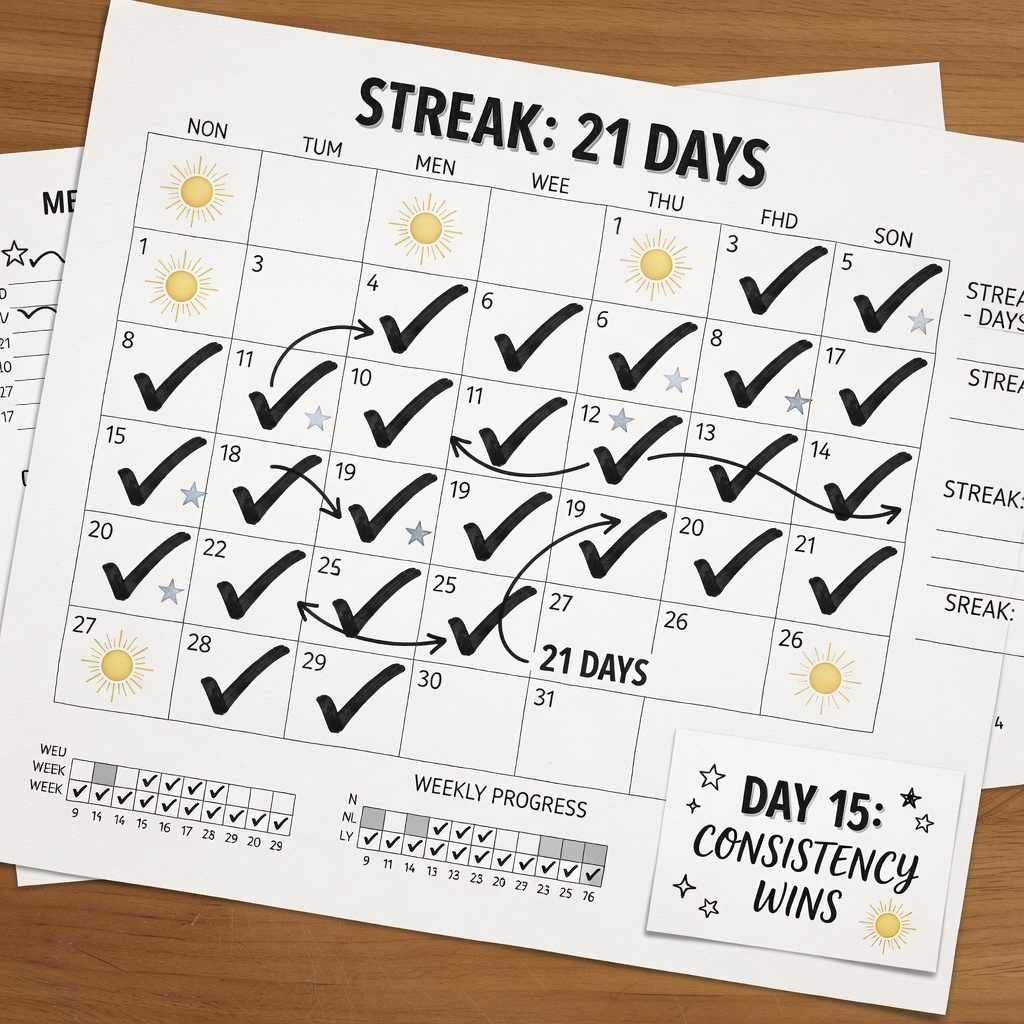
Where Did the 21-Day Myth Come From?
In the 1960s, plastic surgeon Dr. Maxwell Maltz noticed something curious about his patients. After procedures — particularly amputations — it took them approximately 21 days to adjust to their new physical reality. He observed that it took a minimum of about 21 days to effect any perceptible change in a mental image.
Maltz published this observation in his 1960 book Psycho-Cybernetics, which sold over 30 million copies. The self-help industry grabbed this single observation — made about physical trauma adjustment, not habit formation — and built an entire mythology around it. Within decades, the "21-day rule" had become gospel, repeated in productivity books, wellness blogs, and corporate training programs worldwide.
But here's what nobody told you: Maltz himself said "a minimum of 21 days." He never claimed this was the endpoint. And he was talking about something completely different from daily behavioral habits.
What the Research Actually Shows
The most rigorous study ever conducted on habit formation was published in 2010 in the European Journal of Social Psychology. Dr. Phillippa Lally and her colleagues at University College London recruited 96 participants and tracked their habit formation over 12 weeks.
Participants chose a simple behavior they wanted to make automatic — eating a piece of fruit at lunch, drinking a glass of water before breakfast, doing 50 sit-ups after their morning coffee — and performed it every day while reporting how automatic it felt.
The results dismantled the 21-day myth completely:
"The real number: 66 days on average. But simple habits form faster — as few as 18 days. Complex habits can take up to 254 days. You have far more time than you think."
Habit formation took anywhere from 18 to 254 days, with a median of 66 days. The variation was enormous — and it depended heavily on the type of behavior, the person's consistency, and the context in which the habit was practiced.
Why Some Habits Form Faster
Three key factors consistently predicted how quickly a behavior became automatic:
- Simplicity — The simpler the behavior, the faster the habit. Drinking a glass of water after waking up takes around 20 days to become automatic. Training for a marathon every morning may take the full 8 months.
- Consistency of context — Doing the behavior at the same time, in the same place, dramatically accelerates automaticity. The brain forms associations between environmental cues and actions. When those cues are stable, the habit wires faster.
- Intrinsic enjoyment — Habits we genuinely enjoy become automatic faster. This is why forcing yourself into a habit you hate is not just miserable — it's scientifically less efficient.
The Automaticity Curve
Lally's research showed that habit automaticity follows a predictable curve — rapid initial gains that plateau over time. Here's what that actually looks like across the weeks:
| Phase | Effort Level | What's Happening | Automaticity |
|---|---|---|---|
| Week 1 | Very High | Deliberate, conscious effort required | |
| Weeks 2–4 | High | Decreasing friction, building momentum | |
| Weeks 5–8 | Moderate | Moderate automaticity, still needs intention | |
| Weeks 9–12 | Low–Moderate | Increasingly automatic, habit is forming | |
| Week 16+ | Low | Near-automatic, true habit territory |
The plateau is real: automaticity gains are fastest in the early weeks, then gradually level off. This is why so many people feel like they're "almost there" for a long time — they are. True automaticity is approached asymptotically, never fully reached, but becoming powerfully strong over time.
Missing a Day Won't Ruin Your Habit
Perhaps the most liberating finding from Lally's research was this: missing a single day had no meaningful impact on the overall trajectory of habit formation.
Study participants who missed one day were no worse off than those who maintained perfect streaks. Their habit development continued on the same curve after they resumed. The key variable wasn't perfection — it was the overall consistency across the full observation period.
Miss a day? No problem. Miss two? Start getting concerned. Miss three? You're starting over — not because of science, but because re-initiating the behavior becomes increasingly difficult as days accumulate.
This doesn't mean streaks don't matter. They matter enormously for motivation and momentum. But the fear of "ruining" a habit by missing one day is scientifically unfounded — and that fear itself causes more harm than the missed day ever could.
Practical Implications for Your Tracking
What does this research mean for how you actually build habits? Here are the evidence-based takeaways:
- Start with behaviors that take under 2 minutes to complete. Build the neural pathway first, expand the behavior later.
- Anchor new habits to an existing one — do them at the same time and in the same place every day to leverage environmental cues.
- Use visual tracking to see your progress. The act of checking off a habit increases commitment and provides satisfying feedback loops.
- When you miss a day, don't spiral. Your habit is not lost. Simply resume the next day without self-criticism.
- Commit to a minimum of 12 weeks before evaluating whether a habit has stuck. Quitting at week 3 because it still feels hard is like leaving a race at the halfway point.
- Choose habits you can find ways to genuinely enjoy. Habit science confirms: enjoyment accelerates automaticity.
The Consist Approach
Every feature in Consist was designed with this research in mind. Our streak tracking is built to celebrate consistency without punishing imperfection — because Lally's data shows that what matters is resumption, not perfection. Our template library starts with the simplest possible versions of each habit, letting you scale up as automaticity builds.
The visual habit grid — your calendar of completed days — isn't just satisfying to look at. It's a scientifically meaningful tool. Seeing a pattern of consistency reinforces the behavior through operant conditioning and makes the cost of breaking the chain psychologically salient.

Conclusion
The 21-day myth was never true. But here's why that's actually good news: you have more time than you thought. Habit formation is not a sprint — it's a gradual process that rewards patience and consistency far more than it rewards perfection or speed.
The real insight from Lally's research isn't that habits take 66 days. It's that habit formation is highly personal, highly variable, and far more forgiving than any productivity guru has told you.
Start simple. Stay consistent. Forgive the missed days. Give it three months minimum. The science is on your side.
Apply These Insights with Our Templates
Browse science-backed habit templates designed around the 66-day formation window — starting small and scaling with you.
Explore Templates →