
The Streak Effect: What's Really Happening
When you see a long chain of completed days, your brain does something fascinating — it shifts from thinking about the habit itself to protecting the chain. A 30-day streak isn't just a number. It's a visual representation of identity, effort, and momentum. And your brain treats it like a prized possession.
Streak tracking taps into three powerful psychological forces simultaneously: loss aversion, identity reinforcement, and the power of commitment devices. Understanding how each of these works helps explain why even a simple row of green checkmarks can outperform elaborate motivation systems.
Loss aversion — the principle that losses hurt roughly twice as much as equivalent gains feel good — means that the prospect of breaking a 15-day streak feels far more painful than the benefit of adding day 16 feels good. That asymmetry is what gets you off the couch on a cold Thursday evening when you'd rather skip your run.
Identity reinforcement operates more subtly. Every time you complete a habit and extend your streak, you collect a small piece of evidence about who you are. You're not someone who "tries to exercise." You're someone with a 22-day exercise streak. The distinction matters enormously to the brain.
And commitment devices — structures you set up in advance to hold your future self accountable — work because they remove the daily decision. A visible streak is a commitment device you build one day at a time.
The Jerry Seinfeld Method: Don't Break the Chain
Long before habit tracking apps existed, comedian Jerry Seinfeld had a deceptively simple system for becoming one of the best stand-up comedians alive. He hung a large wall calendar — one of those big yearly ones — and every day he wrote new material, he would draw a big red X across that day.
After a few days, he had a chain. His only job, from that point forward, was to keep the chain going. "Don't break the chain," he reportedly told a young comedian who asked his advice. Not "write better jokes." Not "get more stage time." Just: don't break the chain.
The brilliance of this method is its psychological elegance. It converts a complex goal — become an excellent comedian — into a single binary daily question: did you do the work today? Yes or no. The chain does the rest.
"The chain itself becomes the motivation. You're not writing jokes today — you're protecting the chain."
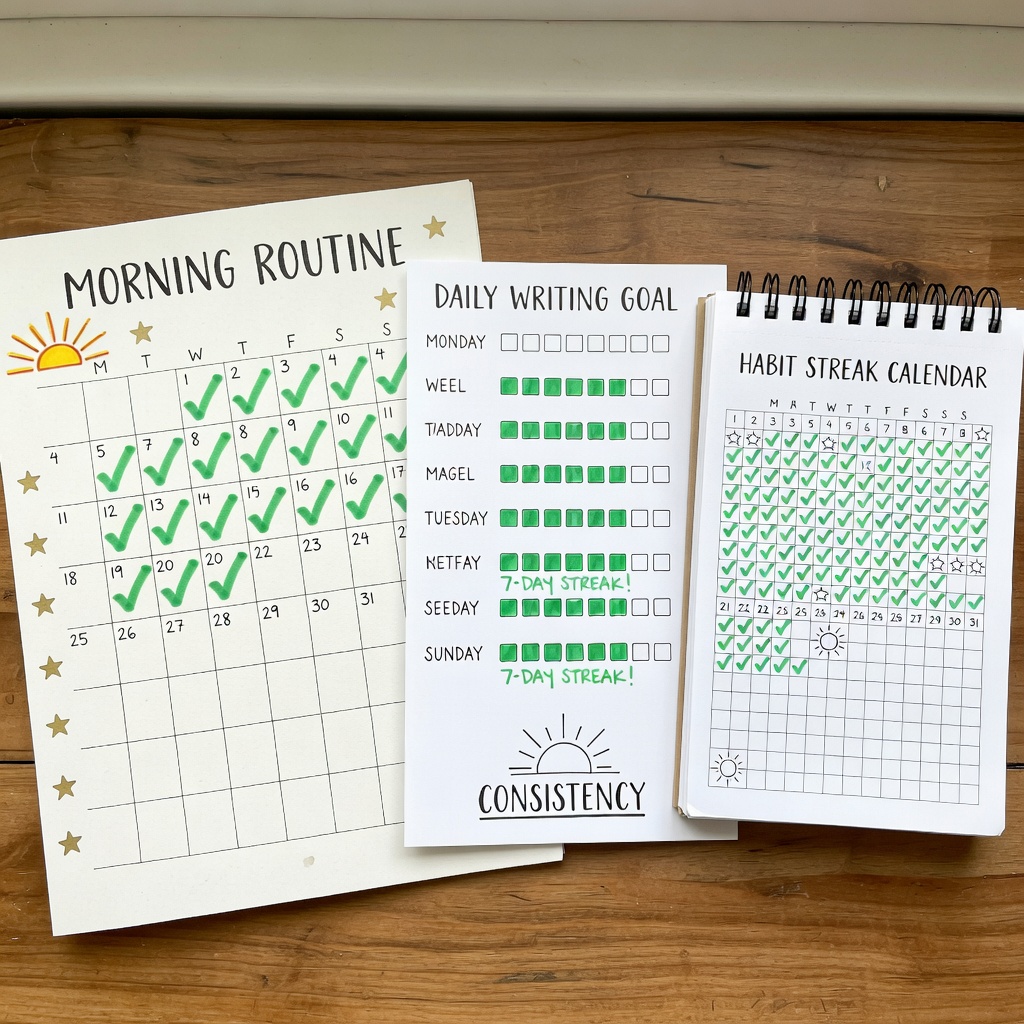
The visual aspect is crucial. Seinfeld didn't keep a spreadsheet or a mental count. He used a physical calendar hung somewhere he'd see it. The growing chain of X's was impossible to ignore, and ignoring it became harder with each passing day. This is why digital streak trackers that show visible progress — colored dots, growing bars, glowing numbers — work better than simple habit checklists.
Why Your Brain Loves Streaks
The psychological pull of streaks comes from at least four well-documented mechanisms working in concert:
- Loss Aversion — Humans feel losses more acutely than equivalent gains. Psychologists Daniel Kahneman and Amos Tversky showed that losing $100 feels roughly twice as bad as gaining $100 feels good. A streak that's in danger of being broken triggers this same asymmetric pain, making you far more motivated to protect it than you'd be motivated to start a new one.
- Identity Reinforcement — Each completed day adds to a growing body of evidence about who you are. Behavioral scientists call this "identity-based habit formation." When you see a 45-day streak, you don't just see a number — you see proof that you are the kind of person who does this habit. That self-concept becomes self-reinforcing.
- Social Proof (Internal Audience) — Even private streaks create what psychologists call an "internal audience" effect. You behave as though someone is watching and evaluating your consistency, even when no one is. Some research suggests this internal observer can be as powerful a motivator as actual external accountability.
- Completion Bias and the Zeigarnik Effect — We are psychologically driven to complete things we've started. The Zeigarnik effect, named after Soviet psychologist Bluma Zeigarnik, shows that our brains hold on to incomplete tasks more persistently than completed ones. An ongoing streak is a task in progress — your brain wants to see it through.
The Dark Side of Streaks (and How to Handle It)
Streaks are a powerful tool, but like any powerful tool, they can cause harm when misapplied. Three patterns emerge most commonly:
- All-or-nothing thinking. A broken streak can feel like total failure, causing people to abandon the habit entirely after one missed day. "I already broke my streak, so why bother?" This cognitive distortion — sometimes called "the what the hell effect" in behavioral science — can erase weeks of progress in a single moment of discouragement.
- Streak anxiety. For some people, the pressure of maintaining a streak becomes its own source of stress. They find themselves completing habits not because they want to, but purely to prevent the anxiety of a reset. When the practice stops feeling good and starts feeling obligatory in an unpleasant way, it's a warning sign.
- Gaming the system. Some habitual trackers learn to "cheat" their streaks — completing a habit in a superficial or abbreviated way purely to preserve the number. This is especially common with journaling (writing a single sentence just to check the box) or exercise (a one-minute walk to avoid a reset). The chain is maintained, but the underlying goal is lost.
"A streak tracker is a tool, not a prison. The moment it creates anxiety instead of motivation, change your relationship with it."
Building a Healthy Streak Practice
The goal isn't a perfect streak — it's a lasting habit. Here are three frameworks for keeping streaks motivating without letting them become tyrannical:
The 2-Day Rule. Popularized by productivity writer Matt D'Avella, this rule is simple: never miss more than two consecutive days. One missed day is an exception. Two missed days is a pattern. This approach allows for real life — illness, travel, emergencies — without triggering the all-or-nothing spiral that kills so many habits.
Flexible Streaks (Weekly Averages). Instead of tracking daily completion, track your weekly average. A "reading habit" might be defined as reading at least 5 out of 7 days. This accommodates natural variation while still providing momentum. It also maps better to how humans actually function — we have good weeks and hard weeks, not just good days and bad days.
Reset Rituals. When you do break a streak — and eventually you will — having a small ritual for restarting without shame makes recovery faster. This might be writing down why the streak broke and what you'll do differently, or simply marking the reset day with a different symbol and starting the count fresh. The goal is to make restarting feel like a beginning, not a defeat.
How Consist Approaches Streaks
Our design philosophy is built around one principle: visual progress should motivate, never punish. That's why the Consist tracker shows your streak prominently but also preserves your full completion history even after a reset. Breaking a 30-day streak doesn't erase those 30 days — they're still there in your calendar, a testament to what you've proven you can do.
We also built in milestone celebrations at 7, 21, 30, 66, and 100 days — points that correspond to meaningful research on habit formation — rather than treating all streak lengths equally. And we're deliberately avoiding the darker patterns seen in some tracking apps, like social pressure mechanics or punitive messaging when you miss a day.
Practical Streak-Building Tips
If you're ready to start using streaks as a habit tool, here's what the research and our own experience with thousands of users suggests:
- Start with a 7-day goal first. Don't aim for 30 days on day one. Chase 7 days. When you hit it, celebrate. Then chase 21. Breaking the journey into stages makes each milestone feel achievable and keeps motivation high between longer milestones.
- Make the habit unmissably small. A streak lives and dies on your worst days. Design your habit to be completable in 2 minutes on a terrible day. "Exercise" becomes "5 minutes of movement." "Read" becomes "1 page." The minimum viable habit preserves the streak; on good days, you'll do more anyway.
- Track in a visible place. Physical or digital, your tracker needs to be somewhere you see it daily. Out of sight is out of mind — and out of mind is how streaks silently die. Phone home screen, bathroom mirror, or your browser default tab are all proven locations.
- Have a backup plan for disruption. Travel, illness, and unexpected life events will happen. Before they do, decide in advance what your "minimum viable habit" looks like in each scenario. Traveling? Your 30-minute run becomes a 10-minute hotel room workout. Sick? Your reading habit becomes one paragraph before bed.
- Celebrate milestones meaningfully. Mark 7, 21, 30, 66, and 100-day streaks with something real — a meal you enjoy, a purchase you've been putting off, a message to a friend who knows about your habit. External celebration reinforces the internal identity shift and makes the milestone feel like a genuine achievement.